
Industrial Air Cleaners & Smoke Filtration
Industrial air cleaners are designed to filter the ambient air of fine, airborne dust and contaminants to provide a better working environment. Air cleaners may be installed in multiples as a stand-alone system to create a planned air circulation pattern for regular whole-room air exchange and filtration, or air cleaners may also be used in conjunction with source capture equipment for a total air filtration solution.
Smoke filtration systems provide effective filtration of smoke, dry chemicals, mineral dust, metallic dust, oil mist, powders, rubber dust, wood dust, ceramic dust, and welding smoke fumes.
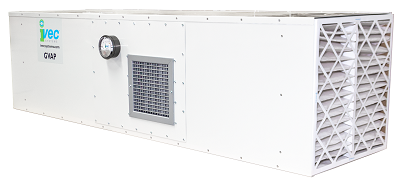
IVEC Systems General Ventilation All Purpose
Why Your Operation Needs Industrial Air Filtration
Industrial air filtration helps control airborne contaminants that migrate beyond point-of-capture systems, reducing residual smoke and fine particulate buildup throughout the workspace.
By continuously circulating and cleaning ambient air, these systems support regulatory compliance, protect sensitive equipment, and improve overall employee comfort and productivity.
Facilities that rely on welding, machining, or finishing processes highly benefit from a properly designed smoke filtration system that limits cross-contamination between work zones. For larger facilities, an industrial air filtration system built around commercial-grade air cleaners provides scalable, energy-efficient air quality control without disturbing operations.
Ambient Air Cleaning vs. Source Capture: Where Each One Fits
Source capture pulls contaminants at the point of generation, but no capture system catches everything. Fugitive smoke and fine particulate routinely escape hoods, extraction arms, and local exhaust ventilation, then drift across the floor and settle on equipment and lungs alike. That residual load is the problem an industrial air cleaner is built to solve.
An ambient air cleaner attacks the contaminants that source capture leaves behind. Instead of pulling at a single point, it continuously draws in the surrounding air, filters it, and pushes clean air back into the space, establishing a planned circulation pattern. Source capture removes the bulk of the contaminant at the weld joint or machining station; ambient air cleaning scrubs the fugitive emissions that get past it. Run together, the two form a complete industrial air filtration system that keeps both the breathing zone and the wider facility within target air quality levels. For weld shops and mixed-process floors where capture alone falls short, our ambient fume and dust solutions close the gap.
Industrial Air Filtration Equipment Features
Hastings Air Energy Control provides industrial air filtration with a choice of filter systems: application-specific media, multi-stage filters, HEPA after-filters, and self-cleaning cartridge filters for heavy-duty applications.
All of our industrial air cleaners are designed for tool-free, easy maintenance and high-efficiency performance, recirculating clean, tempered air. We offer our industrial air cleaner line in various configurations, including free-hanging units, free-standing modular styles, and ducted or integrated systems with source capture arms.
Industries utilizing free-hanging air cleaners include:


How to Size an Industrial Air Cleaner for Your Facility
An undersized industrial air cleaner cannot keep pace with the air volume it needs to clean, and an oversized one wastes energy and space. Correct sizing for industrial air filtration starts with the room, not the product. Three inputs drive the calculation: square footage, ceiling height, and the contaminant load your processes generate.
Those inputs produce a target airflow, measured in cubic feet per minute (CFM), and a target number of air changes per hour (ACH). Most industrial environments with moderate contaminant levels are designed for roughly 6 to 12 air changes per hour, with heavier smoke and dust processes pushing toward the upper end. A 30,000-cubic-foot weld bay at 8 ACH, for example, needs to move 240,000 cubic feet of air every hour. High ceilings and dense particulate raise the requirement further.
Because a single cleaner rarely covers a large or multi-zone floor on its own, units are commonly deployed in multiples to build an even, whole-room push-pull circulation pattern with no stagnant pockets. Fixed-airflow models run continuously for simple operation, while automation-controlled units let you match airflow to demand and reduce energy draw during lighter shifts. If you are unsure of your numbers, our engineers will size your industrial air filtration system against your actual square footage, process mix, airflow requirements, and suspended particulate height.
Typical Processes
Air cleaners from Hastings Air Energy are filtering the air in all kinds of industrial environments, for processes such as:
- Sanding
- Grinding
- Buffing
- Welding
- Soldering
- Machining
Contaminants and Smoke an Industrial Air Cleaner Removes
Different processes throw off different contaminants, and matching the right filter stage to each one is what separates an effective industrial air cleaner from an underperforming one. A commercial smoke filtration system built for a weld shop is not configured the same way as a unit handling oil mist or fine wood dust.
A multi-stage industrial air cleaner addresses the full range of industrial airborne contaminants:
- Weld smoke and fume, including the fine and submicron particulate that lingers longest in the breathing zone
- Oil mist and smoke from machining and metalworking
- Metallic, mineral, and ceramic dust from grinding, cutting, and finishing
- Wood and rubber dust from sanding and fabrication
- Odors and gaseous contaminants that particulate filters alone cannot hold
Each contaminant is handled by the appropriate stage in your smoke filtration system: a pre-filter knocks down larger particles, a high-efficiency main filter captures the fine fraction, and a HEPA or activated-carbon after-filter polishes submicron particulate and odor. For facilities fighting persistent haze and smell, our odor, fume, and smoke filtration configurations target exactly that load.
Our experts can help you save money by creating a custom solution perfectly fit for your application.
Industrial Air Cleaners FAQs
Industrial air filtration cleaners help manage lingering smoke, fine particulates, and airborne contaminants that escape source capture systems or where source capture isn't the best option. By cleaning the ambient air continuously, industrial air cleaners reduce employee exposure, minimize dust accumulation on equipment, and support safer, more consistent operations.
Source capture systems remove contaminants at the point of generation, while industrial air cleaners function as a secondary layer by filtering the surrounding air. Use them together, and they create a more complete industrial air filtration system.
While requirements vary by application and jurisdiction, many facilities use industrial air filtration to help meet OSHA, NFPA, ACGIH, EPA, and local air quality guidelines.
Absolutely! Industrial air cleaners are commonly deployed in multiples to support large spaces or segmented production areas. Companies like Hastings Air design industrial air filtration cleaners to scale with facility size, process demands, and airflow requirements without disrupting the production floor plan.
Replacement intervals depend on filter type and contaminant load, not a fixed calendar. Pleated pre-filters are typically changed every one to three months, while high-efficiency bag and cartridge filters often last six to twelve months. The most reliable signal is pressure drop: when a gauge shows airflow restriction climbing, the filter is loaded and due. Heavy smoke and dust environments shorten every interval. Hastings stocks replacement filters for most major brands of industrial air cleaners and dust collectors.
Operating cost comes down to two factors: the energy the fan draws and the filters you replace over time. Clean filters keep airflow resistance low, so the fan works less and pulls less power; a clogged filter raises both energy use and motor wear. Units with automation controls cut consumption further by matching airflow to demand. When comparing systems, weigh the total cost of ownership, including filter price and availability, rather than the purchase price alone.
Ambient units are usually mounted on the ceiling or high on a wall so they can establish a circulation loop that sweeps the entire room rather than one corner. Placement should reinforce the natural airflow of the space and avoid dead zones where contaminants settle. In larger facilities, multiple units are positioned to work in a coordinated push-pull pattern. A facility assessment confirms the right count and placement for your layout.
Get an Industrial Air Cleaner Sized for Your Facility
You know where source capture is falling short and where contaminants are settling. The next step is an industrial air cleaner matched to your square footage, process mix, and airflow targets. Our engineers will assess your floor, recommend the right configuration, and help you control air quality without disrupting production.
Request an Industrial Air Cleaner Quote | Schedule a Facility Assessment


