
Combustible Dust Hazards in Industrial Facilities
Combustible dust remains one of the most persistent safety risks in industrial manufacturing.
Fine particulate generated during cutting, sanding, grinding, conveying, drying, or blending can accumulate quickly and create serious fire and explosion hazards if not properly managed. Facilities processing wood, grain, food products, metals, plastics, chemicals, or pharmaceuticals are all affected, regardless of size or production volume.
This risk often goes unnoticed because combustible dust accumulation develops gradually and exposure conditions change throughout a shift. A facility may appear clean at floor level while combustible material builds up on overhead beams, inside ductwork, or within process equipment. Once ignited, these accumulations can trigger rapid pressure buildup, causing damage that extends far beyond the original source.
Effective combustible dust control requires more than routine cleanup. It depends on engineered systems, verified processes, and a clear understanding of how dust behaves within a working environment.
Our experts can help you save money by creating a custom solution perfectly fit for your application.
Why Combustible Dust Poses a Serious Risk

Many materials that appear stable in solid form become hazardous when reduced to fine particles. As particle size decreases, surface area increases, making the material more reactive. When these particles are suspended in air, ignition can occur at relatively low energy levels.
A dust explosion requires five conditions, commonly referred to as the explosion pentagon:
- A combustible dust fuel
- Oxygen
- An ignition source
- Dispersion of dust into the air
- Confinement
All five elements must be present for an explosion to occur. Removing just one reduces the likelihood of an incident. In industrial settings, prevention efforts focus on the elements that can be controlled through system design rather than operator behavior. In real-world facilities, dispersion and confinement are often the most difficult factors to control, which is why engineered dust collection and ventilation systems play a central role in prevention.
Secondary explosions present the highest level of risk. An initial ignition inside a machine or duct can dislodge layers of settled dust throughout a space, creating a dense airborne cloud that ignites almost instantly. These secondary events are typically responsible for the most severe injuries and structural damage.
Common Sources of Combustible Dust in Manufacturing
Combustible dust can originate from a wide range of industrial processes, including:
- Woodworking and furniture manufacturing
- Grain handling, milling, and food processing
- Metal fabrication and finishing
- Additive manufacturing and powder handling
- Pharmaceutical and chemical production
- Plastics processing and recycling
Dust is often generated at multiple points within a process, not just at cutting or grinding stations. Transfer points, conveyors, mixers, dryers, and dust collectors themselves can all become accumulation areas if airflow and maintenance are not properly managed.
Facilities operating in metals and machining environments face added risk due to the explosive potential of certain metal dusts and the high energy processes involved.
Regulatory Oversight and NFPA 660
OSHA has identified combustible dust as a major workplace hazard for many years, citing incidents that resulted in injuries, fatalities, and total facility loss. While OSHA does not currently enforce a single comprehensive combustible dust standard, it relies on the General Duty Clause and references consensus standards to support enforcement actions.
To address fragmented guidance across industries, the National Fire Protection Association introduced NFPA 660: Standard for Combustible Dusts and Particulate Solids, effective from December 6, 2024. This standard consolidates multiple commodity-specific standards into a unified framework.
NFPA 660 establishes consistent requirements for identifying dust hazards, evaluating risk, and applying protective measures across different materials and processes. While commodity-specific requirements remain, the standard provides a clearer path for facilities that handle multiple dust types or operate across industries.
CSB safety video on its investigation into the fatal combustible dust explosions and fires at the Didion Milling facility in Cambria, Wisconsin, that occurred on May 31, 2017. Length 14:53
Didion Milling Before & After

The Role of Dust Hazard Analysis (DHA)
At the center of NFPA 660 is the Dust Hazard Analysis (DHA). A DHA is a structured evaluation of a facility’s processes, materials, and equipment to identify fire, flash fire, and explosion hazards associated with combustible dust.
This analysis is typically performed with support from qualified combustible dust specialists who focus on testing, risk evaluation, and mitigation planning.
A DHA is not a paperwork exercise. It is the foundation for system design, capital planning, and long-term risk reduction.
Identifying Dust Characteristics and Process Risks
The first step is determining whether combustible dust is present and where it is generated, transported, or stored. Laboratory testing is often required to measure explosibility parameters such as:
- Kst, which indicates explosion severity
- Pmax, the maximum pressure developed during an explosion
These values influence collector selection, explosion protection design, and isolation requirements. Dusts are classified from St 0 (non-explosive) through St 3 (very strong explosion), with many metal dusts falling into the higher categories.
This phase also maps process areas, including dust collectors, silos, bins, ductwork, and enclosed equipment where dust may accumulate.
Evaluating Existing Controls
Once hazards are identified, existing safeguards are reviewed. This includes engineering controls such as dust collectors, explosion vents, suppression systems, and isolation devices, as well as administrative measures like housekeeping schedules, inspection routines, and employee training.
The evaluation determines whether systems are properly sized, correctly installed, and maintained for the specific dust characteristics. Controls that were adequate for one process or production rate may no longer be sufficient after equipment upgrades or throughput increases.
Risk Determination and Mitigation Planning
The final stage of the DHA assesses residual risk and outlines recommended actions. These may include system upgrades, procedural changes, or modifications to housekeeping and maintenance practices.
NFPA 660 requires DHA revalidation every five years. This acknowledges that materials, processes, and layouts change over time, altering the hazard profile of a facility.
Engineering Controls as the Primary Defense
Administrative controls and housekeeping programs help manage dust accumulation, but they cannot replace engineered solutions. Engineering controls are the most reliable way to reduce combustible dust risk because they address the hazard at the point where it is generated.
Effective engineering strategies focus on:
- Capturing dust before it disperses
- Preventing accumulation in occupied spaces
- Limiting confinement and pressure buildup
- Controlling ignition sources within equipment
Industrial air filtration and dust collection systems are central to this approach.
Dust Collection Systems and Risk Reduction
A properly designed dust collection system does more than improve cleanliness. It directly reduces explosion potential by removing fine particulate from the air and preventing layers of settled dust from forming on surfaces.
Key design considerations include:
- Source capture using hoods or enclosures at points of generation
- Airflow consistency to maintain capture velocity under varying production conditions
- Explosion isolation to prevent pressure propagation through ductwork
- Explosion venting or suppression to safely manage internal events
- Grounding and bonding to limit electrostatic ignition
System selection must be based on the results of the DHA. Cartridge collectors, baghouses, and wet collectors each have appropriate applications depending on dust type, moisture content, and explosibility.
Advanced control systems can improve performance by adjusting airflow based on demand, maintaining effective capture while reducing unnecessary energy use.
Ongoing Risk Management
Combustible dust hazards don’t remain static. Production changes, new materials, and equipment modifications can introduce new risks without obvious warning signs. Facilities that rely on outdated systems or informal practices often discover deficiencies during inspections or incident investigations.
A sustainable dust management strategy includes periodic review, system maintenance, filter replacement, and alignment with current standards. Clean air and dust control should be treated as operational requirements, not secondary considerations.
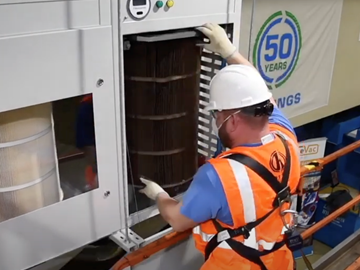
Our experts can help you save money by creating a custom solution perfectly fit for your application.
Supporting Safe and Compliant Operations
Hastings works with industrial facilities to evaluate dust risks, support Dust Hazard Analysis efforts, and design dust collection and air filtration systems that align with NFPA 660 and OSHA expectations. Our focus is on practical solutions that reduce risk, support compliance, and fit real production environments.
Facilities handling fine particulate or combustible materials benefit from reviewing their current dust control strategies before problems surface.
Browse our combustible dust protection products designed for a range of industrial applications.
Frequently Asked Questions
Any material that can burn may become combustible when reduced to a fine particulate. This includes wood, grain, sugar, plastics, rubber, pharmaceuticals, and metals such as aluminum, magnesium, and iron.
NFPA 660 requires DHA revalidation every five years. Revalidation may also be needed sooner if processes, materials, or equipment change
Yes. Dust collectors handle concentrated particulate and must be designed with appropriate explosion protection and isolation based on the dust’s explosibility characteristics. When properly designed, protected, and maintained, dust collectors are safe and essential components of industrial dust control systems.
Air filtration and dust collection systems remove fine particulate before it settles on surfaces. By limiting accumulation and dispersion, these systems reduce the likelihood of large secondary dust clouds forming during an ignition event.