
Dust Control Booths, Tables & Downdraft Tables
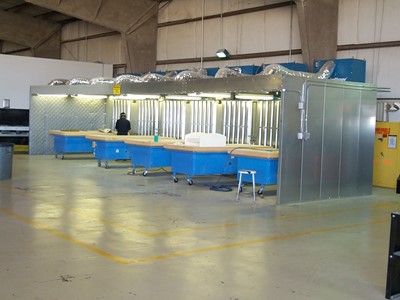
Hastings Air is proud to offer top-quality industrial downdraft tables and dust control booths designed to meet the unique needs of our clients. A downdraft table captures dirty air at the source, and our wet and dry downdraft/backdraft tables do it without slowing your team down. Our industrial downdraft tables and environmental dust control booths use high-efficiency air filters plus "Regain Air" to draw contaminants away from the worker's breathing zone without hindering movement or reach.
Our dust control booths and tables are especially useful for larger pieces while sanding, grinding, buffing, and welding. A specialty of ours is finding the right solution for volatile materials which may require wet dust collection to dampen the explosive dust into a sludge.



Wet vs. Dry Downdraft Tables
Dry downdraft tables capture dust in cartridge or bag filters and work well for most sanding, grinding, and welding. Wet downdraft tables pull dirty air through water, which knocks down sparks and dampens combustible dust into a sludge before it can build up in a filter. If your team works with aluminum, titanium, magnesium, or other combustible dusts, a wet downdraft table is often the safer choice. Our engineers will review your material and process against NFPA requirements and recommend the right system.
Downdraft Tables for Sanding, Grinding, and Welding
A downdraft sanding table keeps fine dust off the floor and out of the air during finishing work. For grinding and buffing, downdraft tables capture heavier particulates and sparks at the work surface. For welding, a downdraft or backdraft table pulls fumes away from the welder before it rises into the breathing zone. Tell us the size of your largest parts and what you are removing, and we will size the table or booth to match.
Industries We Serve
Downdraft tables and dust control booths show up on shop floors across a wide range of industries. Metal fabrication and machine shops use them to capture grinding and welding dust at the bench. Automotive manufacturers and vehicle repair and body shops rely on them for sanding, prep work, and paint booth adjacent tasks. Woodworking shops use downdraft tables for finishing and sanding, while boat and shipbuilding operations use them for fiberglass and composite work. Whatever your industry, we’ll help you match the right table or booth to your process.
How to Size a Downdraft Table
Getting the size right starts with three questions: how big is the largest part you’ll work on, how much dust or fume does the process generate, and what airflow does the filter need to pull to keep up. A table that’s too small forces awkward positioning and lets dust escape past the edges. Undersized airflow lets contaminants drift into the breathing zone even on a table that’s physically large enough. Our engineers look at your part dimensions, process (sanding, grinding, welding, or buffing), and material before recommending a table size and filter combination, so contact us with your specs and we’ll size the right system the first time.
Resources


Why Choose Hastings Air Energy Control, Inc?


FAQs
A downdraft table is a work bench with a perforated top that pulls air down through the work surface into a filter. Dust and fumes are captured at the source, before they reach the worker's breathing zone.
A dry downdraft table captures dust in filters. A wet downdraft table passes the air through water, which dampens combustible or explosive dust into a sludge. Wet collection is often the right choice for volatile materials.
A backdraft table pulls air horizontally into a rear hood instead of down through the work surface. It suits work where the part covers much of the table top or where fumes rise rather than fall.
Our downdraft tables and dust control booths are used for sanding, grinding, buffing, polishing, cutting, and welding, especially on larger pieces.
Yes. We offer portable downdraft tables for welding, soldering, woodworking, and grinding, and compact laboratory downdraft tables for bench work.